L'Oréal – ProSource
CPG: Health & Beauty
Sales Enablement
Digital Products
Strategy + Transformation
Intelligent Systems
Sales + Employee Enablement
Client
L'Oréal
Timeline
2022–Ongoing
Services
Sales Enablement


Challenge
The Street didn't need more content. It needed a better way to use it.
L’Oréal Professional Products Division had a wealth of resources supporting its brands, products, offers, education, and salon programs. For the field sales team, however, having information available and having the right information available in the moment were two different things.
Representatives moved through full days of salon visits and customer conversations that could shift quickly between products, education, merchandising, promotions, pricing, and broader business opportunities. Existing resources lived across different formats and locations. Team members often personalized their own materials. L’Oréal-issued laptops were not always practical in the salon. And anything presented to a customer needed to be current.
In a selling environment built on relationships, time spent searching for information was time taken away from the conversation.
The opportunity was not to create another repository. It was to understand how the Street actually worked, and design a system around it.
Strategic Insight
Before defining the platform, Fluence went into discovery.
We interviewed 10 L’Oréal stakeholders and field users across PPD to understand what representatives did before, during, and after a salon call: how they prepared, what they presented, what customers asked, which tools helped, where existing resources broke down, and what information mattered at different moments in the relationship.
A clear pattern emerged. Field teams wanted easy access to current, well-organized selling material that could be used flexibly and readily shared with customers. They needed self-directed, random-access navigation rather than a prescribed presentation. They wanted mobile-friendly resources and greater confidence that the information in front of a salon reflected current business priorities.
But the research revealed something larger than a usability problem.
Successful salon conversations could not be organized around products alone. Representatives needed to understand what a salon was trying to accomplish and connect that need with the right combination of brands, education, programs, merchandising, and business opportunities.
The selling system therefore had to bridge three things: salon needs, field-team resources, and L’Oréal’s business priorities.
Design around the salon conversation, not the content library.

What We Created
A digital selling environment built for the Street.
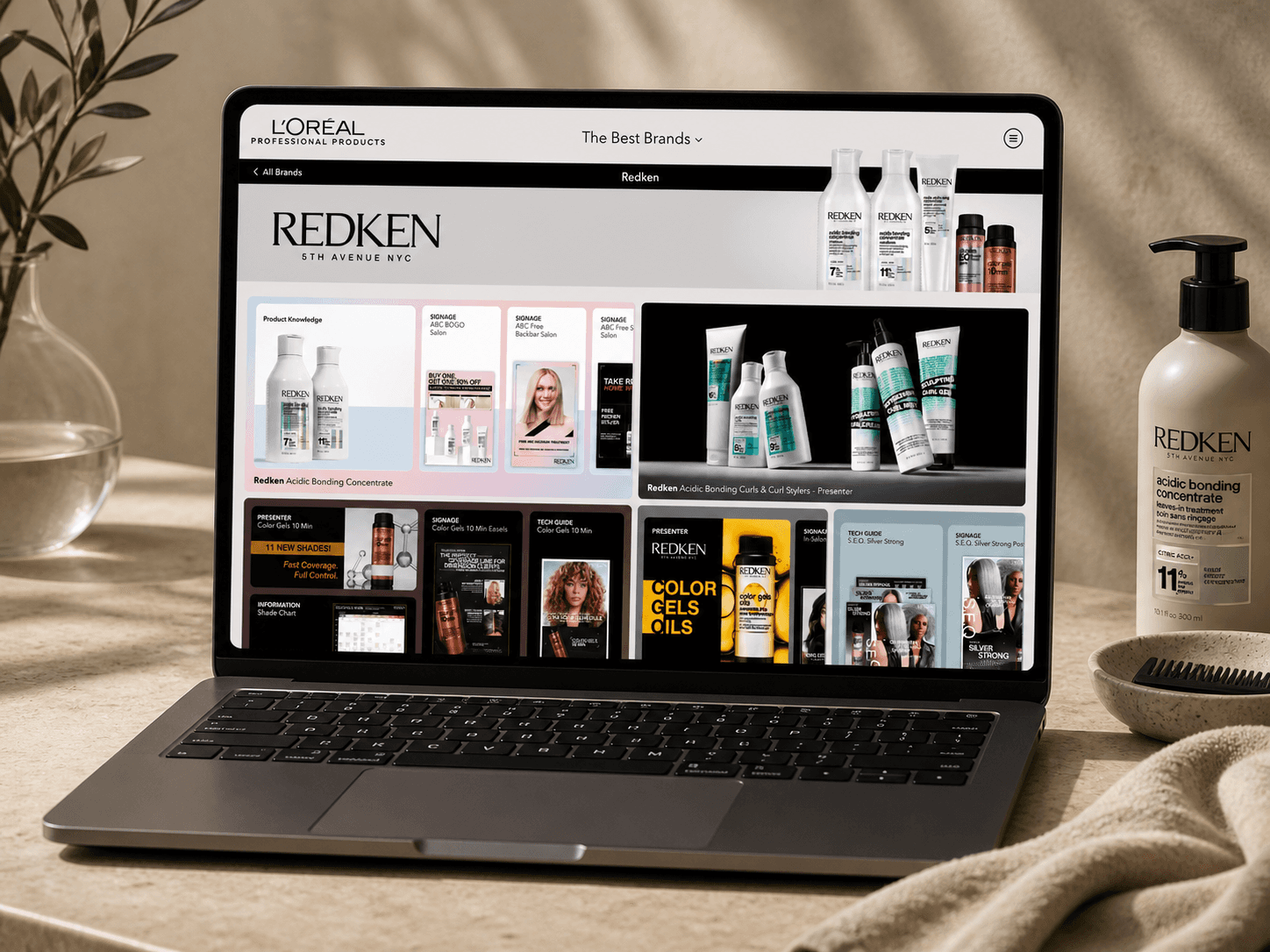
ProSource transformed a sprawling ecosystem of PPD content into an organized, continually updated experience designed around real selling situations.
Rather than forcing representatives through a fixed presentation, the platform supported flexible exploration, allowing the conversation to determine where the experience went next.
ProSource brought PPD’s professional portfolio into one cohesive environment, giving representatives easy access to brand-specific product, pricing, education, and sales resources while preserving each brand’s identity and priorities.
Monthly sell-through guides, program overviews, and sales resources helped field teams connect L’Oréal’s priorities with opportunities for salon growth and stronger business conversations.
Education resources, videos, guides, events, and planogram materials were incorporated into the same environment, giving representatives a more direct path to resources that could support salon teams before and after the immediate sale.
Research showed that selling could not depend on a single device. ProSource supported laptops, tablets, and phones, giving the Street greater flexibility to bring digital resources into different customer environments and closer to the actual conversation.
Product information, offers, price lists, monthly priorities, and business content could be maintained centrally, giving representatives a shared source of current selling material without requiring them to continually rebuild or reconcile their own resources.
Platform analytics captured navigation pathways, interactions, content consumption, and time spent—creating a feedback layer that could help L'Oréal understand how resources were being used and inform future selling, training, onboarding, and sell-through content.
RESULTS + SIGNALS
What success looked like.
The strongest signals were not a single launch metric, but the progression of the work: field research became an active cross-device selling platform, the platform continued to receive updated content, usage could be measured through analytics, and the relationship expanded into additional sell-through and decision-support experiences.
Field Research
10 L’Oréal stakeholders and field users helped shape the platform around real salon conversations, content needs, and technology constraints.
Platform Usage
A preserved 2024 analytics snapshot recorded 1,998 ProSource sessions, providing a measurable signal of platform use.
System Evolution
The work grew from 2022 field research into an active selling platform and expanded into additional sell-through and decision-support tools.


WHAT THIS PROVES
Sales Enablement
Digital Products
Strategy + Transformation
Intelligent Systems
Sales + Employee Enablement
Related Work