S&P Global — Talent & Leadership Development
Financial Information & Analytics
Strategy + Transformation
Sales + Employee Enablement
Client
S&P Global
Timeline
Multi-year relationship
Services
Talent & Leadership Development


Challenge
Leadership expectations were becoming clearer. The development experience needed to make them usable.
S&P was sharpening its business strategy and recognizing that realizing it would require corresponding shifts in how people led.
Its emerging leadership model connected enterprise priorities to specific behaviors; how leaders understood customers, made decisions, developed people, collaborated across boundaries and delivered results. Leadership was being positioned not as a separate HR concern, but as a way to activate business strategy and the company’s evolving operating model.
At the same time, those expectations had to work across very different developmental moments. Enterprise-wide leadership learning, emerging leaders, senior executives and coaches didn’t need the same experience.
They needed to feel connected to the same larger system.
Strategic Insight
Different leaders need different kinds of development. The opportunity was to create connective tissue across them: shared ideas and recognizable structures that could travel from one experience to another, while allowing each program to work for its particular audience and purpose.
That principle was present from the beginning. Early Talent Management work called for a system that could be recognizable, sustainable and expandable across training, communications, print and digital applications. At the same time, competency work was defining what effective HR and talent leadership meant in practice: connecting human-capital strategy to business strategy, developing and retaining talent, raising managers’ ability to coach, and helping leaders own people initiatives.
Leadership Essentials then translated enterprise strategy into six clear expectations: Operate Outside-In. Adopt a World View. Speak the Truth. Elevate People. Drive Performance. Execute with Discipline.
A Strategic Learning Map connected those behaviors visually to the company’s customers, business model, vision, mission and Essential Intelligence promise. Participants explored the visual together, worked through scenarios and questions, compared perspectives and formed their own conclusions. Facilitators were instructed to guide rather than teach.
The experience then brought the conversation down to the individual level: What needed to shift? What could get in the way? What would each leader start, stop or continue doing? Define the system. Translate it into behavior. Design experiences where leaders could practice it.
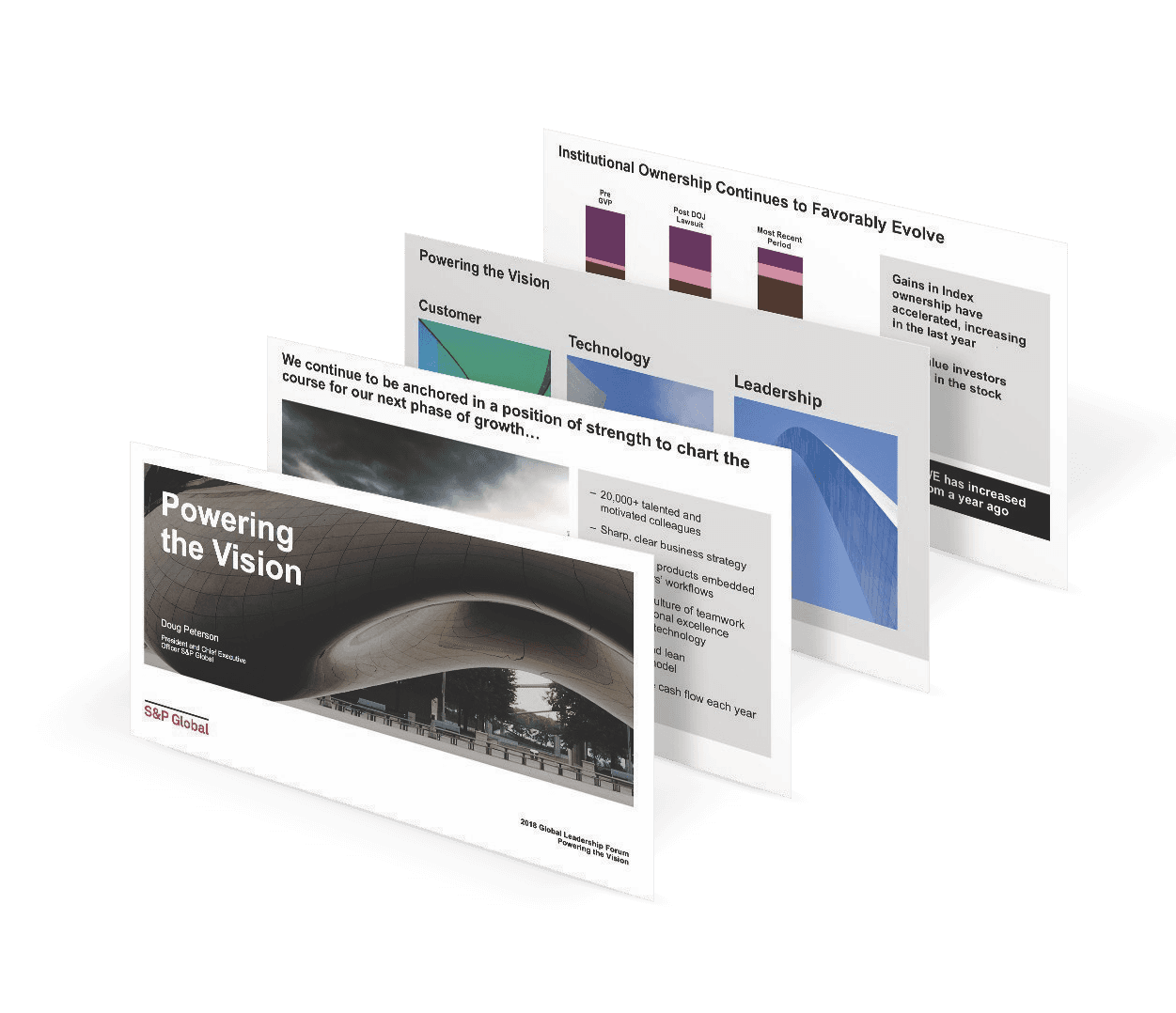
What We Created
A connected development experience, built to flex.
Across multiple years and initiatives, Fluence helped translate Talent Development strategy into the systems and experiences surrounding the learning itself.
Sometimes that meant establishing identity and visual language. Sometimes it meant helping complex leadership ideas become approachable and participatory. For CEO Leadership, it meant connecting an extended journey through workbooks, executive presentations, strategic-challenge tools, reflection materials, participant communications and the physical environment.
Designed for a small cohort of senior executives preparing for broader enterprise responsibility, the CEO Leadership Program combined assessment and coaching, senior leaders as teachers, cross-business teams, real strategic challenges, peer feedback and deliberate reflection. Development happened through the work, not apart from it.
A 126-page workbook carried learning, exercises and reflection through the program. A 43-page Action Learning Guide supported the strategic challenges between sessions. Executive presentations brought senior leaders’ perspectives into the experience. Biographies helped participants understand the people around them. Welcome materials, personalized pieces, agendas, logistics and environmental graphics connected everything from arrival through reflection.
No single component was the experience… The system that conencted them was.
Talent Management, Leadership Development and program identities designed to create continuity across an expanding development portfolio.
Materials that translated HR competencies, leadership expectations and enterprise strategy into clearer behavioral language.
Leadership Essentials and other participatory experiences designed to move leadership ideas from explanation into discussion and application.
CEO Leadership materials and touchpoints connecting assessment, executive access, strategic challenges, reflection and development.
Workbooks, action-learning guides, presentations, facilitator materials, communications and supporting resources.
Emerging Leaders, Leadership/Learning Xchange, leadership-event support and 360 Coaching materials for different developmental moments.
RESULTS + SIGNALS
What success looked like.
Fluence wasn’t repeatedly asked to reproduce one successful program. The work moved from talent systems to leadership behaviors, from enterprise-wide learning to executive development, and from emerging leaders to coaching. CEO Leadership itself continued beyond its inaugural year. As S&P Global changed, Talent Development remained active within the company’s evolving people strategy. The work could change because the system was built around something more durable: making complex development ideas clear enough to experience, and useful enough to act on.
A leadership model made actionable
Leadership Essentials connected enterprise strategy to specific behaviors, scenarios, discussion and personal commitments.
Executive development designed as a journey
CEO Leadership connected assessment, coaching, executive access, strategic work and reflection across an extended experience.
A relationship built to evolve
Fluence's work expanded across leadership levels, program types and the transition from McGraw Hill Financial to S&P Global.


WHAT THIS PROVES
Strategy + Transformation
Sales + Employee Enablement
Related Work