PepsiCo – Marketing Application Contract Repository
CPG: Enterprise Marketing Technology
Digital Products
Strategy + Transformation
Intelligent Systems
Client
PepsiCo
Timeline
EIGHT-WEEK ENGAGEMENT
Services
Information Architecture + Workflow Design

Challenge
Scattered records. Uneven confidence. No shared renewal model.
Contract, application, renewal, ownership, vendor and supporting-document information existed across multiple records and individual team knowledge. The issue was not a lack of information. It was that the information did not always carry consistent relationships, completeness, lineage or accountability.
That made it harder to know which agreement was current, who owned the next action, when renewal preparation should begin and whether the available evidence was strong enough to support a decision. The assignment was to strengthen the repository already underway and create a more usable operating foundation around it.
Strategic Insight
The problem was not simply where contracts were stored. It was whether the knowledge surrounding them was designed to guide action.
Applications needed to connect to vendors, agreements, documents, owners, lifecycle stages, renewal requirements and systems of record. Once those relationships were defined, the repository could support more consistent reporting, readiness decisions and future workflows instead of functioning as a passive document library.

What We Created
A governed contract-management foundation built to connect portfolio knowledge with renewal readiness.
Fluence assessed the repository work already underway, defined the underlying information architecture, created a repeatable renewal-readiness model, and designed the reporting and workflow requirements needed for the next stage. Together, the work formed an implementation-ready foundation for organizing contract knowledge, clarifying ownership and preparing more consistent decisions without unnecessarily rebuilding the system PepsiCo had already started.
A 20-table relationship model connected applications, vendors, agreements, documents, owners, renewals and systems of record across six operating domains, preserving the relationships required for governance and reporting.
Folder, versioning and agreement-lineage standards defined how contract families, active versions, child agreements and supporting evidence should be organized for current use and historical traceability.
A structured intake and scoring model translated application context, commercial exposure, dependencies and governance requirements into prioritized 60-, 90-, 120- and 150-day renewal-planning pathways.
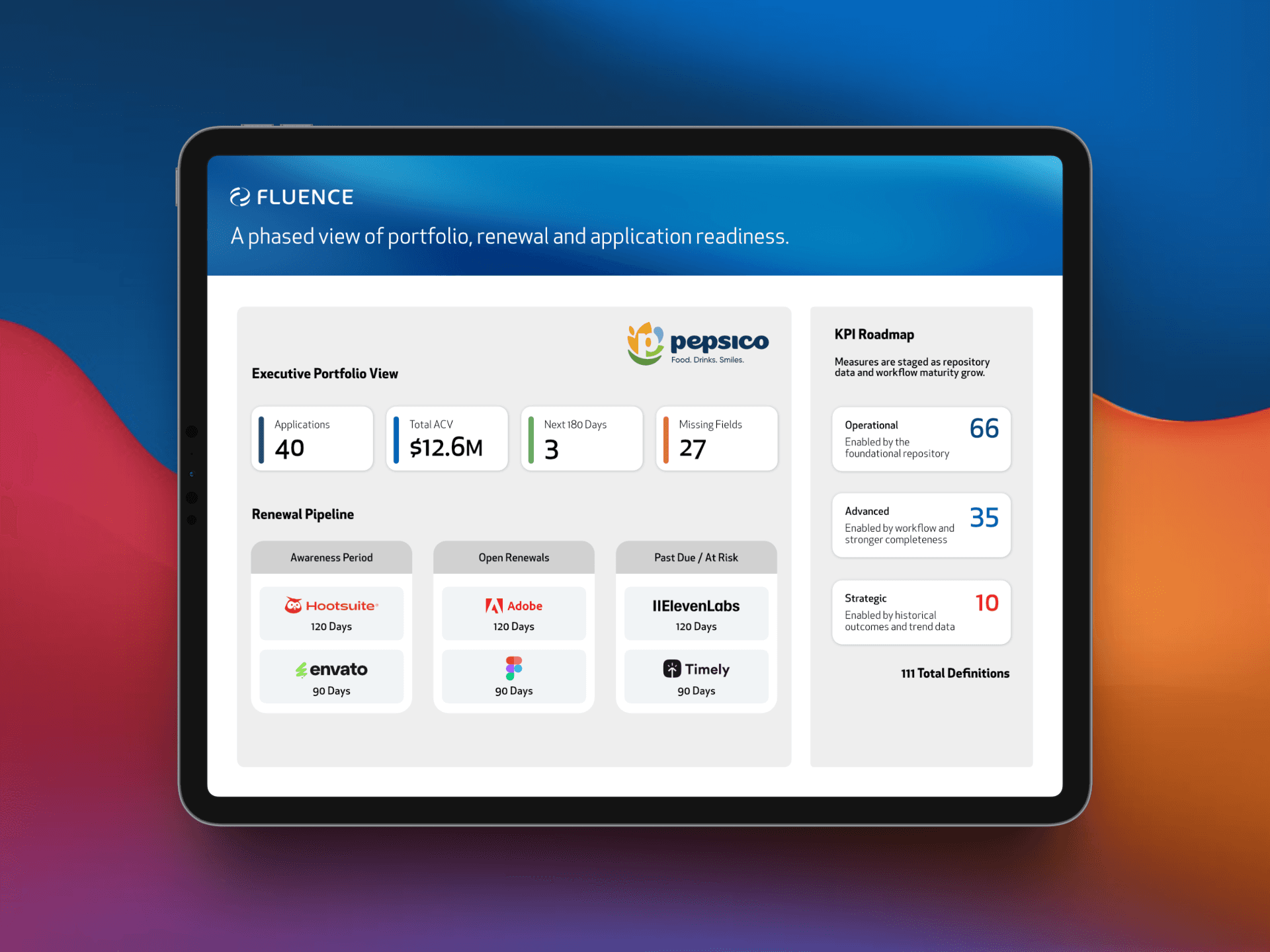
A phased roadmap defined 111 KPI measures, three reporting concepts and the triggers, recipients, timing and linkbacks required for renewal and purchase-order workflows.
Lifecycle stages, maturity outputs, controlled classifications and reusable decision logic provided a consistent framework for maintaining and extending the repository over time.
A portfolio framework organized ~70 marketing apps into a unified ecosystem view, exposing ownership, integrations, commercial relationships and dependencies to support renewal planning, vendor management and governance reporting.
RESULTS + SIGNALS
What success looked like.
The engagement created the connected structure and decision logic required to move from document storage toward governed, decision-ready contract knowledge.
CONNECTED FOUNDATION
A governed architecture linking core portfolio, ownership, financial, renewal and document information across six operating domains.
REPORTING ROADMAP
A phased measurement model spanning 66 operational, 35 advanced and 10 strategic definitions.
RENEWAL PLANNING MODEL
60-, 90-, 120-, and 150-plus-day pathways supported by maturity and data-confidence scoring.


WHAT THIS PROVES
Digital Products
Strategy + Transformation
Intelligent Systems
Related Work